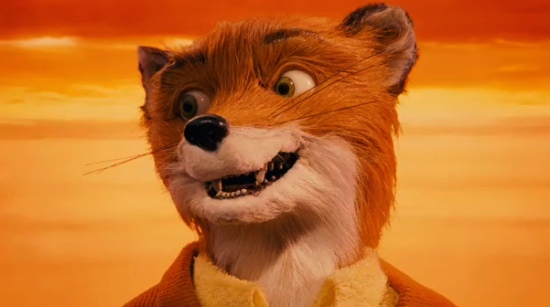
 I have not read the original book, The Fantastic Mr. Fox, by Roald Dahl, and I'm not sure how this one had escaped me. I must have read the plot summary before, but it probably seemed slight compared to other books in the Roald Dahl canon. Roald Dahl, for his part, was always the ideal writer for frightening the crap out of me. I first became familiar with Mr. Dahl's work in the first grade, when a substitute teacher read The Twits. She must have been surprised when I needed to be removed for weeping so hysterically midway through the novel, as she couldn't possibly have known that I had never been exposed to a story like that before. Disney kind of took the edge out of the Brother Grimm, and Hans Christian Andersen made me weep, but The Twits were unmistakably mean-spirited and cruel. As I grew older my distaste and fear gradually turned into a fascination and admiration with almost all of the works of Roald Dahl. While this fox story isn't as terrifying as the other ones it survives in the same cruel universe where animals can lose their tails if they step out of line. The psychoanalyst in me wonders if this interest is somehow connected to a story relayed in Dahls autobiography Boy, where he nearly loses his nose, but I digress. The world is the same in all the stories, cruel and with monsters or horrible people, and one has to fight to survive. In other words, it's a lot like the real world.
So the fox is hung up on keeping up with the Jonse's. He was a former criminal, I must admit I adore kids' books that where hero is a criminal. But again, he is just trying to survive, if he gets a little greedy it's because his ego gets a little carried away, but he is not a bad fox. He probably should have kept his promise to his wife when she announced that she was pregnant but he steals chickens from the three farmers Boggis, Bunce, and Bean. The farmers are so mean the schoolchildren have made a song about them, and they are vindictive as they try to catch the fox, blowing up a hill in the process and dislocating a bunch a animals that also are trying to survive.
Dahl's sensibility lends itself well to Anderson's sensitivity. The fox's son is extremely jealous of his very like-able cousin, whose comes to live their after losing his father. In a beautiful scene that the director describes here, he chastises his cousin, turn off the lights and hears him crying, then he get's up and turns on a train. In a modern age where actors begin to resemble virtual video-game humanoid-type things, it's remarkable how Anderson can infuse his animal dolls with such humanity and life. The characters talk, have interests, complain, weep, and dance. There's an almost unsettling realness to them.
This film is peculiarly politically incorrect for a kids movie. First of all, let's just say we must accept that we root for other animals than we do in the great film Chicken Run, or otherwise be driven mad by the moral quandaries. Also, some of the bad guys smoke, and booze, and a rat addicted to booze becomes integral to the part. A fantastic line concludes the rat's appearance. There's some other great touches like the badger eyes, and I liked how only the humans had English accents. Also, the film is rated PG for some 'slang-humor' a term that sounds less funny than it plays in the film.
 The movie is as enjoyable as anything. If you've seen any other Wes Anderson movies you know his style is perfect for this type of animation. He like to set up scenes like a child playing with toys while listening to cool music. The camera often-times stays on a two-dimensional plain, with the characters truly inhabiting their settings. The effect is like watching a series of intricate dioramas in motion. But this would just be attractive portraits if the characters weren't so compelling. The characters feel authentic, they aren't perfect, but who is? As one character notes: there's something kind of wonderful about that.


Another view.
ReplyDeletehttp://www/slate.com/id/2236156/
http://www.slate.com/id/2235461/
ReplyDelete