Friday, October 30, 2009

It Might Get Loud


Ahhh, the rockumentary. I’m old enough to have seen The Song Remains the Same and Tommy in the theater. And I thoroughly enjoyed Val Kilmer as Jim Morrison in The Doors…those were the days, when Classic Rock was contemporary.

OK, so it’s been a while. So I thought I’d take my son, who’s just at the age to discover music, to see It Might Get Loud. It was a good parent-kid experience, especially since it can be a challenge for a parent to connect with their teenager at times.

The movie is anchored by a gathering between Led Zeppelin’s Jimmy Page, U2’s The Edge and Jack White of the White Stripes. They come together to share their individual experiences of their musical beginnings, their unique electric guitar knowledge and experience, and the paths of their careers.

These guys get pretty technical over the electric qualities of their guitars and how they use the electric nature to carve out their own individual sounds. That appeals to the tech-head in me and I can’t say it’s anything I had really thought of while listening to Where the Streets Have No Name. Of course, when you hear and see Jimmy Page playing his double-neck with a bow, not to mention a theramin, you get the idea that they love to experiment with electricity. Add to the gathering that they jam together on some numbers and it is pretty fun.

Interspersed with the gathering, we get vignettes of each artists life: Pages idyllic English country estate and his voluminous vinyl collection, The Edge’s beach studio with stacks of demo tapes, and an upholstery shop in Detroit where Jack White’s first band, The Upholsterers, got its name. Each tells a bit of their family history, what was going on in the world of music, and the world of politics, that formed their styles. We learn about The Edge’s writing debut in Sunday Bloody Sunday and his emotions of the time in Northern Ireland. We learn how Led Zeppelin achieved the uniquely huge drum sounds of When the Levy Breaks. And we learn about Jack White’s love for Blues roots and how he incorporates them into his punk sound. For me, there were moments of ‘I remember that’ and moments of ‘I didn’t know that.’

What I found different and refreshing about this rockumentary is that it wasn’t simply a concert performance with some outtake interviews of members of one band. It was more about the guitar and the players’ experience with that instrument. It was about coming together as musicians and learning from other accomplished musicians.

The ending song by the trio, the Band’s The Weight was a lot of fun…especially when Jimmy revealed ‘I can’t sing.’

Friday, October 23, 2009

Zombieland


Transcending horror, 'zombie' has now become a genre of its own.  We have zombie Jane Austen, zombie banks, zombie buddy comedies (Shaun of the Dead), zombie art house (28 Days Later)...and now with Zombieland we have the zombie rom-com.

The movie isn't very deep.  I repeat, it's not very deep.  But it actually is a pleasant romantic comedy, with likable characters, and funny asides.  The lead Michael Cera-type is adorably goofy.  His narration is comforting, as he guides us to his rules of survival in zombieland.  We figure 'hey, if this goober can survive in zombieland, we probably could.'  The opening is a little grisly, though it's a nice use of Metallica's 'For Whom the Bell Tolls.'

The first act is actually the best, as it explains the zombie rules it's pretty funny.  This is good, I mean, how annoying is it to see someone whack a monster, only to stand around not making sure it's dead?  Zombieland rules fix that problem.  The movie has a nice anarchic tone at this point, and again, it's not very deep.  It's more of the variety of 'wouldn't it look cool to see a car crash and a human fly through the window in slow motion, or watch a zombie girl get her head smacked back by the very top of a toilet tank?'  Yeah, kind of.  In this way it works it's date-movie demographic pretty well, addressing the fan boys before settling into it's boy meets girl story. 

Woody Harrelson get's the best lines, and is fun to watch.  Then we meet the two sisters, Abigail Breslin, and a bad ass Zooey Deschanel-type.  The way they meet is pretty intense, but after this the tension deflates considerably and the movie becomes a more straight-forward comedy.  The film is also clever as it has the characters make the most out of their situation.  Don't you sometimes think, in films about post-apocalyptic worlds, that it might at times be kind of fun?   These characters don't neglect that, though they are well rounded enough to miss their dead families.  The movie is never a downer, though.

What else?  Oh, one of my favorite actors has a cameo as himself, and the clown scene is pretty freaky.

Friday, October 16, 2009

Outrage


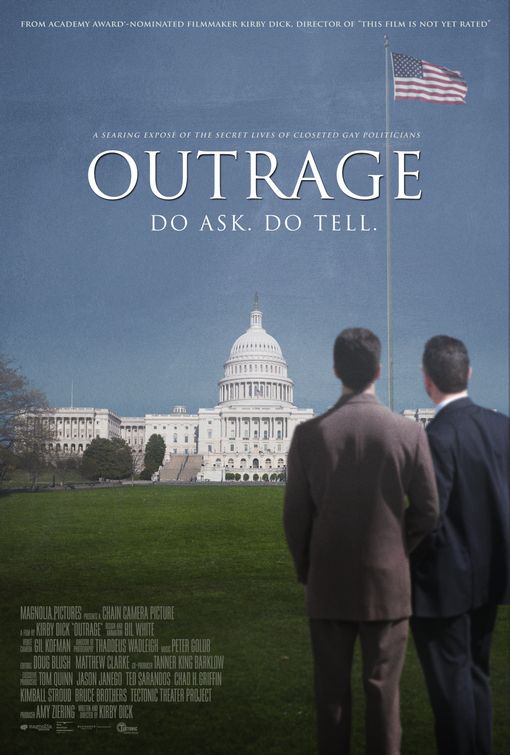
Outrage is a documentary about closeted gay politicians.  It goes through a list, touching upon sexual rumors and accounts, then dissecting their voting records.  Many are still closeted like Larry Craig, Charlie Christ, and Ed Koch.  Others are more repentant about their abuse.  The film concludes that openly gay politicians will be more sympathetic to equal rights for gay people, as opposed to closeted gay people.  Well, men.  Republican men. It's mostly Republican men.

The beginning is handled sensitively.  It starts with Larry Craig, it exposes an already told story.  It goes even further to detail his treatment of others.  He is shown thoroughly to be a hypocrite.  For a moment the film pauses to look at the whole picture, filling us in on the environment that Craig grew up in, so we understand to an extent, why he is the way that he is.


This formula is repeated throughout except for that last step.  With the other politicians we can deduce that their upbringing and  environment made them closeted.  It's like they shut down a part of themselves, to an extent where they have no empathy for others who were in their situation.  They don't want to have empathy, because, to them, that would mean the unthinkable.  They must expunge and segregate themselves from that which they fear, then they blame, judge, castigate, and cast aspersions.  They deny everything from domestic partnerships to adoption.  This is how one can tell it is unjust.  It affects people who have nothing to do with it, it hurts whole families, not just individuals.


The theme of erasure emerges.  The opening line of the film is a terrifying statement, the rest of the film eventually proves to be true.  A scene of Bill Maher naming a name is censored from CNN.  It is not just that it happens, it is that it is pushed upon society.  There really is a conspiratorial effort to suppress our existence.  It is not just this film that make me think this.  Just this morning I saw a biography on Montgomery Clift that was about his personal life, but completely omitted the fact that he was bisexual.  The Tectonic Theatre Project, which also produced this film,  recently updated the Laramie Project deals heavily with this occurance, as it exposes the 20/20 special that took the murderers word for it that it was simply a robbery gone wrong, even after he testified in court that it was because he was gay.  Many people would rather take the words of the killer than believe in the final verdict and the officers involved.  'It's like this massive denial,' one of the characters note.  It is a very powerful force instigated by a very hateful agenda. 


But ignorance can only work if people allow it to work.  Films like this cut through the facade.  They cannot forever deny that we exist as people.  Knowing this would mean we deserve equal treatment under the law.


Larry Kramer, who is interviewed in this film, wrote a great piece about homosexual erasure. 

Thursday, October 8, 2009

Capitalism: A Love Story


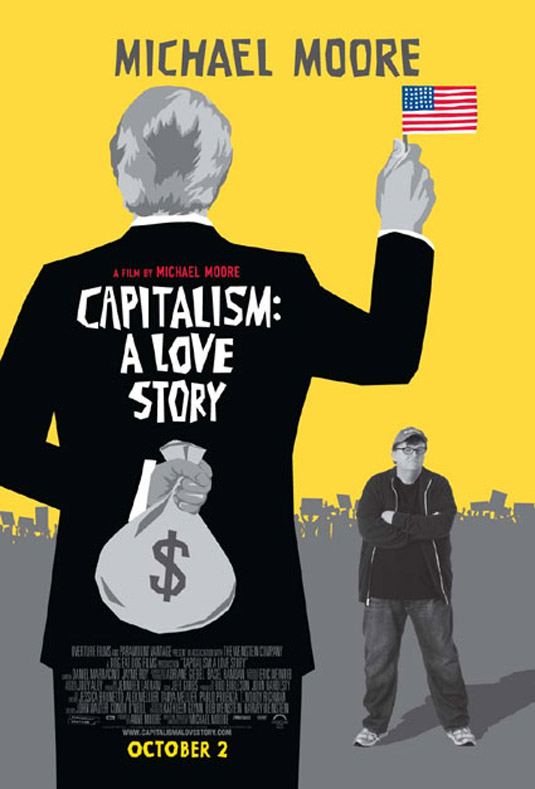
I like old stock movie footage, and short film reels from the past.  I don't always like it when they're spliced into more current footage.  Larry Charles did this a lot in Religulous.  It was funny at times, but  often I would think, 'that's really not necessary,'  they may even be more powerful by themselves.  Michael Moore also uses this technique.  It's condescending, like they don't trust me to reach the correct conclusion of my own.  It must be telegraphed broadly, and fingerprinted to hammer it all in to my thick skull.  

But that is a minor quibble when the message is so glaringly correct.  The USA is Rome, yes.  We worship money, yes.  The movie is most effective when it get's to specific stories of how this affects real people.  Did you know companies can take out life insurance on their employees?  It's called 'dead peasants' insurance.  I sure as hell didn't.  I would figure a detention center could be used for profit, as there is a lot of profit to be made in the justice system. People are priced out of there own homes and properties. 

By focusing on Capitalism, Moore keeps the topic pretty broad.  He argues that all the big calculus people go to wall street to mess with derivatives.  They used to be scientist that made medicine, like the polio vaccination which was for the people.  I think he see the culture of capitalism as creating this greedy climate, but he is broad in his attack.  He minces definitions there, but he paints a case for it with the use of American idealism made in the Reagan era nicely placed after the Carter gloom and doom speech.  The most stirring speech, however, is saved for the end as FDR presents his vision for a second Bill of Rights. 

This is presented after a hopeful segment, where the movie actually becomes uplifting.  Chicago factory workers triumph.  Neighbors show support for a family house squatting in Detroit.  At moments like this, true meaning is given to the words 'power to the people."  This is more moving than Moore attempting to make citizens arrests, though it's funny when he puts crime scene tape around Goldman Sachs.

Moore has always been too good of a showman to simply sway us with logic.  The most brilliant scene of his, I still think is from Roger and Me, where he shows the CEO of General Motors reading an ode to the poor from A Christmas Carol, juxtaposed with a laid of workers family being evicted.

Say what you will about the style, and it's 'provocative' nature.  This film is good because it holds true ethics, reminding us that there is a conscience in liberalism and of our moral obligation to each other.  It is thoroughly American, and decidedly Christian.  I hope it makes bank.