Saturday, December 26, 2009
Avatar
Anyhow, when a movie about basic goodness, reverence, and decency is declared Marxist propaganda you know that someone has lost touch with their inner child. Because really, that's all that is being expressed. I once saw a bumper sticker that declares, 'the earth is not my mother.' I thought of that bumper sticker during the movie when Netyri tells Jake Sully, the young marine, that he is 'like a child.' Indeed, it takes a real childish personality type to declare oneself separate from the earth. But she eventually schools him.
As far as the other criticism that this is anti-soldier, that is preposterous. The director has given us some of the best action sequences of all time, and has used marines as heroes. That he comes around to identifying the destructive nature of war is a reality no director could dismiss while making a film that resembles reality and not glorified war propaganda. Furthermore, if you pay attention to the plot, you know that the marines that come in at the end are mercenaries hired by a corporation, not government soldiers. This is anti-Merc, anti-Blackwater (Xe) anti-privatization of our armed forces.
On the left, the criticism is more valid, but with equal tunnel vision. The notion that this is like the old colonial tales, masquerading as an anti-colonial tale is interesting, and the most valid notion in the article when-will-white-people-stop-making-movies-like-avatar. However the emphasis on race and white-guilt blocks the writer from taking in any other themes. Yes, this sci-fi fantasy is allegory, what sci-fi fantasy isn't? In this allegory we deal with actual issues, and yes, race is one of those, but it is not the ONLY issue. The exploitation of resources, our connection to nature, and the possibilities of technology are summarily dismissed in the writers obsession with all things racial.
All this aside, I really enjoyed this film. It is the best event movie since the Lord of the Rings. It has been criticized for being overly simple, but these are archetypes, mythos, not complex characters. Being overly complex would confuse the point. Also some say a lot of the dialogue is dumb. Why? I sense a certain ethnic condescension in this point. Certainly the new-age mythology can seem hokey, but no more so than it did in the Lord of the Rings. Is it somehow less hokey when inspired by Anglo-Celtic mythology rather than Afro-Indigenous mythology? No, they are equally hokey, and interesting, and a lot of fun. This was a very fun film, a beautiful world to get lost in, and the most life-affirming blockbuster since E.T.
Monday, December 21, 2009
Iron Man II

Tuesday, December 15, 2009
Wednesday, December 2, 2009
Black Dynamite
Saturday, November 28, 2009
The Fantastic Mr. Fox
I have not read the original book, The Fantastic Mr. Fox, by Roald Dahl, and I'm not sure how this one had escaped me. I must have read the plot summary before, but it probably seemed slight compared to other books in the Roald Dahl canon. Roald Dahl, for his part, was always the ideal writer for frightening the crap out of me. I first became familiar with Mr. Dahl's work in the first grade, when a substitute teacher read The Twits. She must have been surprised when I needed to be removed for weeping so hysterically midway through the novel, as she couldn't possibly have known that I had never been exposed to a story like that before. Disney kind of took the edge out of the Brother Grimm, and Hans Christian Andersen made me weep, but The Twits were unmistakably mean-spirited and cruel. As I grew older my distaste and fear gradually turned into a fascination and admiration with almost all of the works of Roald Dahl. While this fox story isn't as terrifying as the other ones it survives in the same cruel universe where animals can lose their tails if they step out of line. The psychoanalyst in me wonders if this interest is somehow connected to a story relayed in Dahls autobiography Boy, where he nearly loses his nose, but I digress. The world is the same in all the stories, cruel and with monsters or horrible people, and one has to fight to survive. In other words, it's a lot like the real world.
The movie is as enjoyable as anything. If you've seen any other Wes Anderson movies you know his style is perfect for this type of animation. He like to set up scenes like a child playing with toys while listening to cool music. The camera often-times stays on a two-dimensional plain, with the characters truly inhabiting their settings. The effect is like watching a series of intricate dioramas in motion. But this would just be attractive portraits if the characters weren't so compelling. The characters feel authentic, they aren't perfect, but who is? As one character notes: there's something kind of wonderful about that. Monday, November 23, 2009
Star Trek
- The entire story is given to you in a “mind-meld” between Spock and Kirk. I didn’t like this. It took about five minutes and it told you everything you needed to know. I think this is, essentially, a parlor trick. Why not use the film to tell the story? Or, you could do one of those Star Wars thing and tell the story at the beginning of the film in written form. At any rate, I thought it was silly and just gave the producers an excuse to bring back the old Spock.
- What was up with the two wild animals on the planet Kirk was sent to? Here he finds himself on this planet where, for miles, you see virtually nothing but snow and ice. Out of the blue, bam, there’s a wild animal chasing him! What’s up with that? And, as if that’s not bad enough, bam, another, bigger animal eats the one chasing him and then starts chasing Kirk! The whole thing lasts about two minutes with Spock saving him. Where the hell did the animals come from???
- Back to the “mind-meld” thing. I think the whole movie is ruined by the story that Spock shares with Kirk. In this story, Spock is asked to save a planet from an exploding star that is on a collision course with the planet. Spock says he can save the planet and sets out to do so. After Spock sets out in his spaceship to shoot the exploding star with some material that will turn it into a black hole, the star suddenly hits the planet! What?? Can no one do math in the future? I mean, can’t you mathematically figure out the trajectory of the exploding star? Spock heads out on his spaceship to intersect the star and seems surprised when the thing hits the planet. This is Spock!!! He should have known before he took off in his little spaceship that he wouldn’t have time. I mean, what the f…??
- That, not being able to calculate the time to impact thing, really ticks me off, but there were a couple of nit-picky things I didn’t like as well. For instance, Captain Pike is too old in this film (if your point of reference is the Star Trek tv series, as it should be. And, what’s up with Pike ending up in a wheelchair?? I mean, obviously, Pike ends up in a wheelchair at some point, but not as a result of a bug getting in his head. How does a bug crawling around your brain cause you to be in a wheelchair?? Also, when Kirk tricks the system to overcome the the Kobayashi Maru, I couldn’t believe how lame it was. I mean, this should have been a big deal! It was treated like a fraternity prank. Lame..lame…lame. Finally, what was up with that miner’s ship? I’m not even going to complain about the fact that a miner was able to destroy an entire Klingon battalion, or that he was able to destroy an entire Federation battalion RIGHT AFTER he destroy’s the Klingon battalion, or how stupid the miner’s ship looks, my question is, what happened to the part of the ship that was in the black hole when Kirk shoots at the ship at the end of the movie. Does the part Kirk hit get destroyed and the part in the black hole ends up just fine? If so, is it now a half a ship? What the hell happens to a ship being fired on when part of the thing no longer exists in that current time?
Wednesday, November 18, 2009
Monday, November 16, 2009
"CORALINE"

Now I know what you're thinking. This movie has been in the video store for months now. First of all why do they still call it a video store? With the many format changes over the years I suppose they should call them DVD stores, or Blu Ray stores... Secondly I have kids, a job, and a busy life so get off my back!
So "CORALINE" is animated stop-motion 3-D fantasy film based on Neil Gaiman's 2002 novel of the same name. Visually it's good, Not great! I enjoyed the stop motion animation very much. I could see Tim Burton's touch on it which I did like. I have to say this is where my good time ended. The 3D was sub par, and fell victim to the usual 3D gimmicks and honestly half way through the movie (While bored) I forgot that it was even a 3D film.
The story goes: Coraline Jones voiced by Dakota Fanning and her parents, Mel and Charlie Jones voiced by Teri Hatcher and John Hogdman leave their nice lives in Michigan and move into the Pink Palace Apartments in Ashland, Oregon. I have to say I didn't realize this while watching the film. Except for the constant rain this was my only clue. Until Wikipedia told me I had no idea!
Coraline and her family shares residence with retired actresses Miss Spink and Miss Forcible (Who are funny I must admit), and retired Russian circus performer Mr. Bobinsky. Making the domicile a who's who of retired boring people.
Now the story, the director, and the visuals had so much potential. I honestly do not, and can not figure out why I didn't like it. I think the thing that bugged me the most was I didn't care what happened to any of the people living in the story. Without sympathy, empathy, love, or hate for any of the people on the screen I found myself thinking about my shopping list, my house and what I need to do next, and God forbid even what I needed to get done at work the next day! Apathy sucks!
Now this is very sad for me, because I love Tim Burton and Henry Selick. I loved "THE NIGHTMARE BEFORE CHRISTMAS" and was super excited to see this film. Just ask my wife! She thought I was a little touched in my noodle as I kept a countdown on when it was released on video (There's that antiquated format term again). Like I said before, I have a busy life so we didn't see it on the big screen. Sadly I have to say I am glad I didn't...
After reading other reviews, and even seeing that it received an 88% certified fresh rating on Rotten Tomatoes I thought myself crazy. After watching it a second time and wasting another $3.79 I am convinced I just did not like it. Rotten Tomatoes, Leonard Maltin, the Dallas Morning News, the New York Times, Globe and Mail, and the Toronto Star can suck it! Best 3D movie ever? Pffffffftttt, I think not! If you want to see a great 3D film go see "A CHRISTMAS CAROL"
Sunday, November 15, 2009
Pirate Radio
In scanners recently, I caught some commentary about a recent book about Robert Altman. It's one of those tawdry and superficial pieces about how Robert Altman is overrated because, apparently, the man liked to party. Not liking that such a groundbreaking filmmaker could have smoked weed, the critic is willing to dismiss the entire canon, though it is far easier to dismiss the critic. Packed in a loose, organic, and improvised style...Altman's films create warm ensembles, unforgettable characters, and vivid environments.Director Richard Curtis said, with his new film Pirate Radio, that he wanted to make a 'rock and roll MASH.' The problem with that is MASH, set in Korea with an old-timey soundtrack, is considerably more rock and roll than Pirate Radio.
Pirate Radio is occasionally cute, and even fun. In a very quick setup, the film explains that the British airwaves only allow for a very brief period of rock music per day, so offshore stations in international waters would fill the void and give the Brits some heavy riffs to rock out to. Then a young protagonist enters the ship to meet his godfather, who seems nice and classy. Then we meet the rest of the party, a dimwit roommate whose personal trait is he never makes sense, a ladies man that I found really annoying...and the rest, silent pretty boy, token lesbian, and the ringleader played by Philip Seymour Hoffman who seems along for the beer.
While the director was going for MASH, and I was hoping for Pump Up the Volume, the result comes off more like a period version of The Life Aquatic with Steve Zessou without the underlying pathos. We witness the 'dark side of rock and roll,' which basically amounts to 'pretty girls go for famous guys' even if they're older and less attractive, apparently. The groupies here leave one yearning for the intelligence of Penny Lane in Almost Famous. They aren't particularly interesting or nice, though many have nice entrance scenes approaching the boat with an appropriate song blaring. Even Emma Thompson gets one of these entrances in a brief role as the kids unlikable mother. At least the lesbian (I can't remember her name) character is nice, and she gets laid too, so, that's good, and the first of the scenes of women approaching the boat is cute, in a Benny Hill sexy party kind of way. If I make this movie sound naughty, it isn't. The sex is of a mostly proper juvenile nature.
So, the British government epitomized by one particularly pompous prig, Kenneth Branagh, and his assistant Twatt tries to shut them down with mixed results. I wonder if it's weird to be in the same film as your ex-wife? It would be nice to see them act together again. Anyways, the party goes on, the kids play chicken, charades, 'I have never...', and drink a lot, though strangely, not when playing 'I have never...'. When the main kids paramour runs astray his buds comfort him with milk and cookies. Really. You'd think they'd be pumping the stomach of an od'ing roadie by now, but no.
So that's about it until the government finally succeeds, and the boat defies them further, risking their own lives. Strangely, the more serious things got, the funnier the film was. There's a nice seen juxtaposing the crew of the ship having a Christmas, and the conservative establishment dude having a very dull one with his family and assistant. Contrasted with the such coldness, the warmth of the crew becomes apparent. You how the director is citing Altman here, assembling not so much a cast, as a party and surrogate family. He follows them, catches side conversations and intimate moments. The film shares the episodic format of MASH, the trick is to get a plethora of natural footage and then hone it down into a narrative. Apparently the American version of this film was edited by 20 minutes from the original British release The Boat that Rocked.
One wonders if that cut was better, because this one is terribly edited. MASH was meandering, but increasingly involving. This is just a series of cut-together montages. We hear very brief clips of excellent songs, but they don't last long enough to ever enthrall the viewer. It's all too choppy, and at the same time overly slick. It doesn't have the patience to let it's ideas ring, it's all streamlined and fabricated like Oceans 13. One gets the impression that it's trying to be cool, and the director gets in his own way. The camera blinks and spasms in a hyper fashion, when it should kick back and take a long slow look, and while Altman used a hand-held camera he was a least kind enough to pick an object and focus on it instead of shaking the damn thing.
Alas, the film is not completely unpleasant. It is cute at times, and a good heart and a healthy disrespect for authority. It reminds one of listening to their favorite radio DJs in the times before podcasts. I always like to listen to the Kinks, or Cat Stevens, and watching 60s period actors cavorting to them is whimsical. The actors are all believable, and the costumes they wear are great. Still, one gets the impression that the true story that inspired this must be a lot more interesting than the film. It makes one feel good, but it's charm wears off the more one thinks about it. Perhaps Richard Curtis was ripped off by his dealer.
Saturday, November 7, 2009
Disney's Christmas Carol"

http://movies.yahoo.com/movie/1810049009/info
This Friday morning my wife and I took our kids to see Disney's "Christmas Carol". Word of caution there are scary scenes.
As you may know having talked or conversed with me on various topics that this "story" is one that I like very much. I always have.
I want to first talk about the sheer beauty of this film.Some 3D movies are only in it for the cheap 3D gimmick. You know, the random excuse for something to jump out or fall into the audience. Of course having nothing to do with the plot. This film uses the 3D format to make the audience say to themselves, with mouths opened and eyes wide, "Wow", "Ohh", "Ahh".
There are the dirty London street scenes, snowy countryside scenes, and the three ghosts each with their own unique image and personality. Without giving too much away I was impressed on how there could be something done within the bounds of these very well know, and beloved characters which are somehow different yet not off putting. At no point during this film did I think to myself, yeah, yeah on to the next ghost. I was looking forward to the next, while not wanting the current ghost to go off screen.
Jim Carrey lends his voice to: Scrooge/ Voice of Ghost of Christmas Past/ Voice of Ghost of Christmas Present/ Voice of Ghost of Christmas Yet to Come.
Gary Oldman lends his voice to Bob Cratchit / Marley / Tiny Tim
While Bob Haskins of ("Who Framed Roger Rabbit") fame lends his voice to Mr. Fezziwig / Old Joe
Without getting into the social, political, or religious implications of this story (too much) I turn my attention to the story. I like how this version sticks pretty close to the book. I found myself thinking about the less fortunate, orphans, and people I work with and for. At the films end I left feeling uplifted, spirit renewed, and ready for Christmas! I know, I know it's only November 7th. I do have to say 99.1 FM will soon start playing Christmas music 24-7...
Bottom line for me was; if you like the story go see this movie. If for no other reason for the 3D beauty, and unique story telling methods used. If you don't care for the story; go anyway simply for the 3D experience. Trust me you'll love it.
Friday, October 30, 2009
It Might Get Loud
Ahhh, the rockumentary. I’m old enough to have seen The Song Remains the Same and Tommy in the theater. And I thoroughly enjoyed Val Kilmer as Jim Morrison in The Doors…those were the days, when Classic Rock was contemporary.
OK, so it’s been a while. So I thought I’d take my son, who’s just at the age to discover music, to see It Might Get Loud. It was a good parent-kid experience, especially since it can be a challenge for a parent to connect with their teenager at times.
The movie is anchored by a gathering between Led Zeppelin’s Jimmy Page, U2’s The Edge and Jack White of the White Stripes. They come together to share their individual experiences of their musical beginnings, their unique electric guitar knowledge and experience, and the paths of their careers.
These guys get pretty technical over the electric qualities of their guitars and how they use the electric nature to carve out their own individual sounds. That appeals to the tech-head in me and I can’t say it’s anything I had really thought of while listening to Where the Streets Have No Name. Of course, when you hear and see Jimmy Page playing his double-neck with a bow, not to mention a theramin, you get the idea that they love to experiment with electricity. Add to the gathering that they jam together on some numbers and it is pretty fun.
Interspersed with the gathering, we get vignettes of each artists life: Pages idyllic English country estate and his voluminous vinyl collection, The Edge’s beach studio with stacks of demo tapes, and an upholstery shop in
What I found different and refreshing about this rockumentary is that it wasn’t simply a concert performance with some outtake interviews of members of one band. It was more about the guitar and the players’ experience with that instrument. It was about coming together as musicians and learning from other accomplished musicians.
The ending song by the trio, the Band’s The Weight was a lot of fun…especially when Jimmy revealed ‘I can’t sing.’
Friday, October 23, 2009
Zombieland
The movie isn't very deep. I repeat, it's not very deep. But it actually is a pleasant romantic comedy, with likable characters, and funny asides. The lead Michael Cera-type is adorably goofy. His narration is comforting, as he guides us to his rules of survival in zombieland. We figure 'hey, if this goober can survive in zombieland, we probably could.' The opening is a little grisly, though it's a nice use of Metallica's 'For Whom the Bell Tolls.'
The first act is actually the best, as it explains the zombie rules it's pretty funny. This is good, I mean, how annoying is it to see someone whack a monster, only to stand around not making sure it's dead? Zombieland rules fix that problem. The movie has a nice anarchic tone at this point, and again, it's not very deep. It's more of the variety of 'wouldn't it look cool to see a car crash and a human fly through the window in slow motion, or watch a zombie girl get her head smacked back by the very top of a toilet tank?' Yeah, kind of. In this way it works it's date-movie demographic pretty well, addressing the fan boys before settling into it's boy meets girl story.
Woody Harrelson get's the best lines, and is fun to watch. Then we meet the two sisters, Abigail Breslin, and a bad ass Zooey Deschanel-type. The way they meet is pretty intense, but after this the tension deflates considerably and the movie becomes a more straight-forward comedy. The film is also clever as it has the characters make the most out of their situation. Don't you sometimes think, in films about post-apocalyptic worlds, that it might at times be kind of fun? These characters don't neglect that, though they are well rounded enough to miss their dead families. The movie is never a downer, though.
What else? Oh, one of my favorite actors has a cameo as himself, and the clown scene is pretty freaky.
Friday, October 16, 2009
Outrage
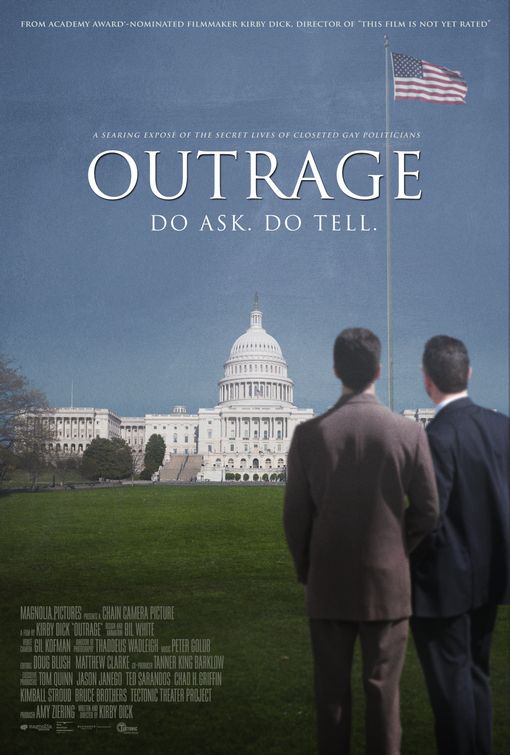
The beginning is handled sensitively. It starts with Larry Craig, it exposes an already told story. It goes even further to detail his treatment of others. He is shown thoroughly to be a hypocrite. For a moment the film pauses to look at the whole picture, filling us in on the environment that Craig grew up in, so we understand to an extent, why he is the way that he is.
Monday, October 12, 2009
Thursday, October 8, 2009
Capitalism: A Love Story
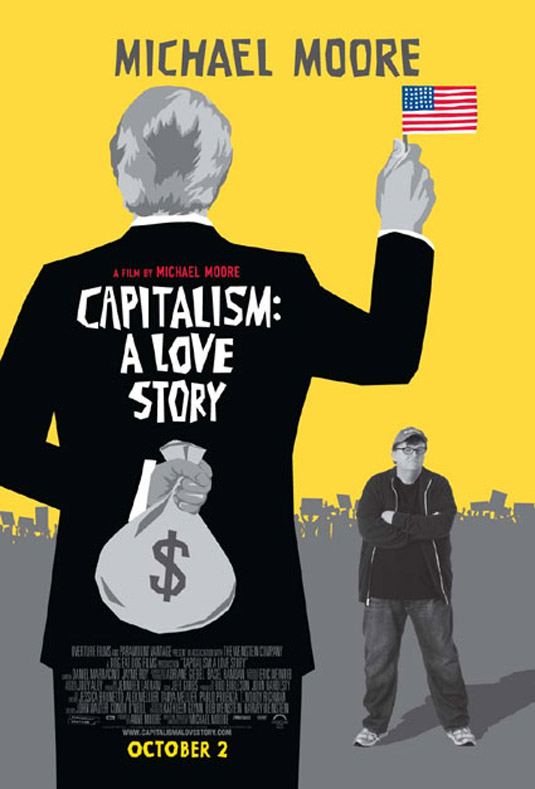
But that is a minor quibble when the message is so glaringly correct. The USA is Rome, yes. We worship money, yes. The movie is most effective when it get's to specific stories of how this affects real people. Did you know companies can take out life insurance on their employees? It's called 'dead peasants' insurance. I sure as hell didn't. I would figure a detention center could be used for profit, as there is a lot of profit to be made in the justice system. People are priced out of there own homes and properties.
By focusing on Capitalism, Moore keeps the topic pretty broad. He argues that all the big calculus people go to wall street to mess with derivatives. They used to be scientist that made medicine, like the polio vaccination which was for the people. I think he see the culture of capitalism as creating this greedy climate, but he is broad in his attack. He minces definitions there, but he paints a case for it with the use of American idealism made in the Reagan era nicely placed after the Carter gloom and doom speech. The most stirring speech, however, is saved for the end as FDR presents his vision for a second Bill of Rights.
This is presented after a hopeful segment, where the movie actually becomes uplifting. Chicago factory workers triumph. Neighbors show support for a family house squatting in Detroit. At moments like this, true meaning is given to the words 'power to the people." This is more moving than Moore attempting to make citizens arrests, though it's funny when he puts crime scene tape around Goldman Sachs.
Moore has always been too good of a showman to simply sway us with logic. The most brilliant scene of his, I still think is from Roger and Me, where he shows the CEO of General Motors reading an ode to the poor from A Christmas Carol, juxtaposed with a laid of workers family being evicted.
Say what you will about the style, and it's 'provocative' nature. This film is good because it holds true ethics, reminding us that there is a conscience in liberalism and of our moral obligation to each other. It is thoroughly American, and decidedly Christian. I hope it makes bank.
Thursday, September 3, 2009
Towelhead
Towelhead is a sort of ‘Lolita meets Metilda’ with Alan Ball’s dark humor laced throughout. Jasira is a half-Lebanese, half-Caucasian girl who’s come of age and has discovered her sexuality. Many of the males in the movie have also discovered her sexuality. Her divorced parents are both neurotics and are more interested in their own selfish needs than in their daughter’s best interests.
The story pushes unspeakable ideas to the mental brink, where we know we are getting into uncomfortable territory and squirming, but sells it as not that far-fetched. When the man next door discovers that Jasira likes looking at his Playboy mags while babysitting his son, the scene is set for a series of events that leads to him sexually abusing her. In the final scene of this sequence, Jasira is complicit in her own abuse. Our jaws might drop at this concept, as in Lolita, but considering her lack of parental guidance coupled with her sexual discovery, it is not too difficult to see that for Jasira boundaries take a while to learn. Ball has an interesting view on just such experiences from his own life in this interview.
Ball’s dark humor is apparent in the quirky characters and their actions, as well as some embarrassing and repulsive scenes. Jasira’s mother, Gail, is so wrapped up in her own needs for companionship that she sends Jasira to live with her father when she discovers that her boyfriend has helped Jasira shave in a bathing suit. She tells Jasira that it is all her fault for not understanding how to act properly around a male. Some months later, Gail wants Jasira back because she split with her boyfriend and is ‘all alone’. When Jasira declines, Gail has a melt-down that is so infantile that one cannot help but laugh at her.
Jasira’s father, Rifat, is a humorous contradiction. He is always on edge and Ball depicts this well when virtually every time the doorbell rings Rifat says, ‘Oh, jeeze, what is it NOW!’ Yet, he is so intent on keeping up appearances and being a good suburbanite, that he takes a deep breath and greets the person at the door with sickening politeness. The flagpole war between Rifat and the neighbor at the start of the Gulf War are hilarious statements on suburban competition and conformity. One of my favorite dialogues in the movie follows. Gail has come to visit Jasira and her father at his house for Christmas and has just arrived:
Gail: Hey, what's with the flag?
Rifat: Oh, I'm supporting the war.
Gail: I thought you were protesting it.
Rifat: I'm protesting one aspect of the war and supporting another aspect. See, the mark of intelligence, Gail, is having the capacity of holding two conflicting ideas in your head at one time.
I will save the repulsive and embarrassing scenes for those who want to see the movie, but Variety states that “many scenes are too preposterous to be realistic.” Perhaps, but with elements of American Beauty and Six Feet Under, the comic relief from these scenes, while offbeat, helps us to get through the more jaw-dropping scenes of Towelhead that we might otherwise not be able to digest.
Sunday, August 30, 2009
Inglorious Basterds
By making this film about the power of film, Tarantino is able to posit very serious questions about the morality of art. If Leni Riefenstahls' The Triumph of Will asks if good art can be immoral, Inglorious Basterds lives in a universe where morality is restored, but our tastes are still questioned. Though a major payback of the experience involves some element of blood lust, it is not a simple revenge tale like Kill Bill. The comeuppance is unevenly handed, and more complex.
While Tarantino uses his style to bold effect, they seem to enhance these themes rather than intercept them. It recalls and older time, when we could let our fancies wander aimlessly about without being shoe-horned into genre conventions. The film, while iconic in its own universe, doesn't seem trapped down by any such formula. It is what it is, and that is not necessarily what one would expect. Echos of his previous films are here, multiple stories and protagonists; a slow deliberate pacing; and a wandering camera that searches around different rooms and coridors, and sometimes people...think of the fifties diner in Pulp Fiction, or O-Ren Ishiis hangout in Kill Bill. Here we have a beautiful movie palace. The scene of Shosanna preparing for the film opening is a sensational highlight, but for the most part the film stays reserved, and remarkably grounded.
Instead of overloading us with a barrage of sensations, the film unfolds gradually, slowly developing interest with sudden revelations. A Nazi officer in a farmers house. The tension is palpable. Yes, that's right, actual honest-to-god TENSION. A lot of modern suspense of horror films, if you forgive the expression, are all money shots. It's all pay off when nothing has been built up. But getting there is most of the fun. When we don't know, what is gong to happen is when our minds play tricks on us. Tarantino teases us with a lot of skill, at times using misdirection, but always a step ahead. Unlike in Deathproof, which at times almost seemed like it was stalling, a little bit is revealed incrementally in a way that builds suspense.
The defining and best signature of a Tarantino film must be the dialogue. Some monologues seem to go on for pages, and yet, it's delightful. Smart people, evil people, good people, all sitting around exchanging ideas. It is, perhaps, the most civilized, and amusing of customs, one wishes for the characters to keep speaking. It to, is an old fashioned notion, taking the time to actually get to know someone, to understand how they work with the exchange of pleasantries, before getting to the unpleasant but necessary matter of killing each other.
List of inspirations for Inglorious Basterds here.
Monday, August 24, 2009
Ponyo
Miyazaki said once you can't inflict your views onto children. You can't give them your impression of the world, but they are perfectly capable of having their own impressions. His respect for kids shows in Ponyo. The themes are simple but mature, magic is possible but reality is still central. The major protagonists are children, and the film is unashamed to have a childlike perspective.
The film is a moving children's book. And if it opens stronger than it concludes, it is only because by that point we are so used to being amazed. From the films opening I was mesmerized. After decades to get used to it, and new technologies to compete with, old school animation still has the power to leave me transfixed. I was not watching a cartoon, I was viewing a painting of the sea coming gloriously to life. I was watching sea creatures, the opening shot took me up on a jellyfish ride. This is where American animation would have gone if Fantasia had been a hit in 1940.
On land everything is penciled in with colored pencils. A young boy finds a fish that got stuck in a jar. But it's a magic fish that turns humanoid after a drop of human blood. It speaks, and eventually gets legs, and is very cute. She gets away and comes back, but not without the boy realizing how much he cares for the fish. On land he lives with his mother, visits the senior home, sends light signals to his father who is out at sea. The boats and peirs are realistically rendered. The sea is dangerous, and beautiful, but so is the food and the paper boats. There is beauty in simplicity. I remember watching Spirited Away with some friends at the Avalon. One of my friends, a seasoned Anime veteran, remarked that there wasn't enough cool stuff , just a bubble and a scene where she was attacked by paper....huh? I said, yeah, a dragon made of paper...pretty cool, huh? He didn't seem to agree.
If I say a lot about how the film looks it's because that is what I am most impressed by. You could say a lot for the films mythology, but I almost don't want to see it from an adult perspective. Boy gets fish, but they're kids. The lesson is simple, it doesn't need to go all Hans Christian Anderson on us. The plot is for kids, if that is unpalatable for you, there is always the artwork to focus on.
The Miyazaki elements are there; the slow mannered pace that finds interest in the slightest of contrivances; the heavy life lessons offered with motivational gusto; the extreme reverence for nature and it's inhabitants. You may say it's not as cool as some of his past films, and maybe it's not, but iat least young kids can enjoy the artistry too. I was wondering if the deliberated pacing would bore some kids, but the ones in the theater remained as transfixed as I. There is enough spectacle to amaze without any frenetic action or explosions. Sure, it's for kids
But did you ever look at the ocean when you were a kid, and while looking did it ever seem like the ocean and its waves were alive?
Tuesday, August 18, 2009
District 9
The first part of the film is an intriguing, but depressing parable. The aliens are mysterious, gruesome, and ugly. They are introduced in the fake news footage, interest story, shaky hand cam way, that is annoying and disorienting, like watching a very depressing news report in the future. It unfolds this way, explaining the word view of how this poor ugly aliens are the biggest of undesirables, like Guantanamo prisoners with AIDS in the 80's times ten. Nobody wants them around. These aliens get no respect, and for a while we're not really sure if they deserve it.
Things get worse as the humans try to illegally evict them from there district, using violent force when necessary. This is about as entertaining as Schindler's List in South Africa with mutated walking-stick crab people. But then something happens, and I won't reveal what, but it changes the direction of the film and eventually gives it purpose. Things go horribly wrong for a central character. And when I say horribly, I mean it's pretty horrible. At this point the fake documentary style is thankfully abandoned and were watching a real horror show.
This is all very disturbing until another turnaround in the plot. This is when the film finally leaps to life and gives me characters to root for. There is alot of film left at this point but it does not get boring. Scene by scene, we watch more improbable scenarios play out. Strangely, the more improbable things got, the more fun I was having.
The aliens and protagonists are placed in the crossfire between militant corporation and Nigerian gangsters, who deal in alien weapons. This gets pretty brutal, my date noted that, at times it got the audience to cheer for the violence. And so it does, and while that's pretty gross, I think the standard action movie becomes a superlative mythos that is cathartic after all the heavy-handed politics. Honestly, I didn't want to see City of God, again, I was ready for a little escapism.
Much is made of the parable, and it is obvious that it was much influenced by Ditrict 6 while South Africa was under apartheid rule. Some say this is an uncomfortable analogy, and it is, what is comfortable about Apartheid? If this is really how whites saw the blacks it is disturbing, though I'd bet if those whites meet these alien prawns they might reconsider and find the blacks and cape-coloureds suddenly don't seem so bad.
This is alot to chew on, but I never really expected to movie to say anything about apartheid expect perhaps that it is a bad thing. I didn't expect the film to be particularly profound, and Peter Jackson the producer said above all it must be entertaining. By starting the film with the brain, and ending with the heart, the film is eventually, entertaining. We witness human beings and aliens being incinerated and turned into goo, but a surprising humanity runs through this film despite it's harsh brutality. We follow a terrifying metamorphesis, only to discover it is actually a characters evolution. In the same way, after I adjusted to the unsettling premise the film becomes surprising, thought-provoking, emotionally moving, and enthralling.
Genesis, with Bruno, Frida, and Woody
Fotios
7/11/09 8:49 p.m.
http://tinyurl.com/nkbnt7
So, did you like the movie? From the writeup it looks offensive...maybe that is the point for seeing it?
I don't know, I find Sacha Baron Cohen over the top...at least I thought Borat was, although I laughed plenty.
I honestly thought it was better than Borat.
The film mines plenty of humor out of the idea of 'gay panic,' and it makes one extremely uncomfortable. The mixture of reality and satire, is also uncomfortable. (To be fair, one scene gave me straight up 'STRAIGHT PANIC').
As to GLAADs protestations, the Anti-defamation league also protested Borat. I read a good essay once, about how we cannot reject certain Jewish characters (say Shylock) because it is bad for the Jews. Borat is a sympathetic anti-semite which is even more offensive, but Cohen the actor is Jewish (but not Gay), yet Bruno is very Gay, if not always sympathetic. I cannot reject Bruno because someone says it is bad for the Gays. Like Borat, I see him as a tool designed to expose the bigotry of others.
The film is sexually explicit, and not in the sweet MILK way, but intensely so. The fact that it got an R rating is astonishing. Truly outrageous. But isn't that how some people see us? Are we not stripped of all identity but sexual in the minds of certain others? Don't they picture a mad caricature fighting with sex toys? This film exposes that.
It is brilliant.
Oh yes, when he adopts a child and takes it on the show, I was uncomfortable. Knowing many wonderful Gay parents I was a little frightened of how this could be perceived. (To be fair, one scene exposes some REALLY AWEFUL heterosexual parents.)
The thing with Ron Paul, and what he says, was very uncomfortable.
These things DO offend me to be honest. I am thankful to see it in front of me, rather than boiling underneath, on the shadow side where we can't talk about things.
The film could be seen as =bigoted and superficial, or as lampooning bigotry and superficiality...and I tend to see the latter. The last bit is nothing short of genius. A bold artistic and political achievement that I still can't stop thinking about, as it figuratively shoves something down a very deserving throat.
Though I laughed often and hard, it was nervous laughter. I enjoy that sort of thing. (I also like Woody Allen's latest, though it's tame by comparison.)
Unlike the recent Pride parade and festival in Corvallis the film Bruno it is definitely for adults only (and probably only open-minded ones at that.)
I'm assuming you are talking about Vicky Christina Barcelona. Yes, that was pretty good. I liked the narrative style of the movie and I liked the way it portrayed relationships as non-traditional, as relationships in real life ARE non-traditional. However, there was one aspect that I really didn't like: Here you had three woman who were so in love with one guy that they could care less about his lack of commitment toward them. I get the free-will concept, but the portrayal is highly unrealistic. I saw it as more of a Woody Allen self-fantasy than as art imitating life.
It's funny, I have a total bias against Allen because of his personal life. When I rented the movie to watch it, I didn't know he was the director, just knew the title from friends' recommendations. Once I saw his name in the credits the whole movie was colored differently for me.
Indeed. Sad commentary.
Actually I was talking about the very latest Woody Allen film, WHATEVER WORKS. Its playing at our local art-house theater right now, (can I name it GT, or is that advertising a business?)
If you thought VICKY CHRISTINA BARCELONA was self-projected fantasy, you won't like this one. It involves Larry David as a suicidal misanthropic genius who becomes involved with a much younger, naive southern woman.
This is insulting, like My Fair Lady, but before it gets too Pygmalion other family members and characters show up revealing unexpected twists in all of the characters.
If you don't like Woody Allen, you won't like it, but it involves three things that I am a sucker for: philosophical rambling, unapologetic romanticism, and unrestrained social liberalism. It also has New York City, Gershwin, and mean-spirited acerbic humor, so I'm sold, but yes, I can see how others will detest it.
A pleasant diversion for me, but wow BRUNO, that one really blew my mind.
Yes, I certainly can appreciate these themes...given another director and I might be sold too. Just my bias.
I was thinking how much I love the movie Frida, which shares some of those themes, plus the tragic component, although in a more realistic fashion...of course it was about real people, so there you have it. Toss in the exotic beauty of Salma Hayek and, well, I think I'll go rent it again.
Oh, and I'll check out Bruno again. I'll have to write you on your page and tell you what I think. Thanks!