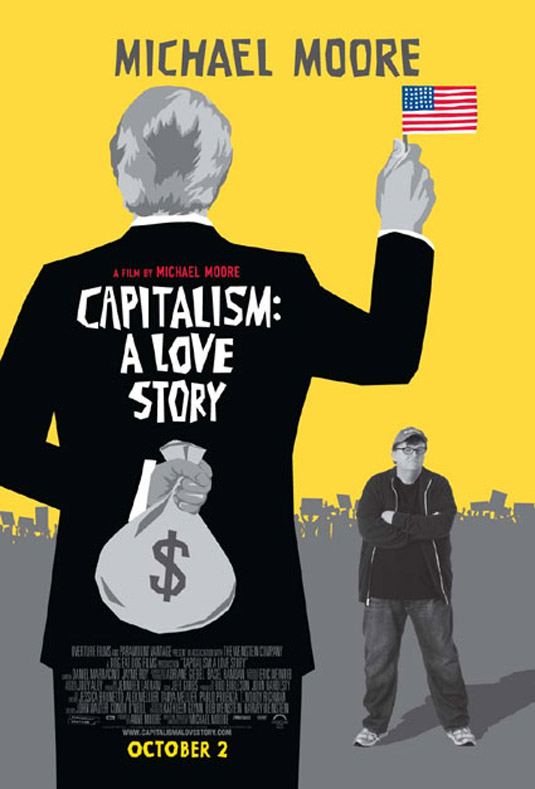
But that is a minor quibble when the message is so glaringly correct. The USA is Rome, yes. We worship money, yes. The movie is most effective when it get's to specific stories of how this affects real people. Did you know companies can take out life insurance on their employees? It's called 'dead peasants' insurance. I sure as hell didn't. I would figure a detention center could be used for profit, as there is a lot of profit to be made in the justice system. People are priced out of there own homes and properties.
By focusing on Capitalism, Moore keeps the topic pretty broad. He argues that all the big calculus people go to wall street to mess with derivatives. They used to be scientist that made medicine, like the polio vaccination which was for the people. I think he see the culture of capitalism as creating this greedy climate, but he is broad in his attack. He minces definitions there, but he paints a case for it with the use of American idealism made in the Reagan era nicely placed after the Carter gloom and doom speech. The most stirring speech, however, is saved for the end as FDR presents his vision for a second Bill of Rights.
This is presented after a hopeful segment, where the movie actually becomes uplifting. Chicago factory workers triumph. Neighbors show support for a family house squatting in Detroit. At moments like this, true meaning is given to the words 'power to the people." This is more moving than Moore attempting to make citizens arrests, though it's funny when he puts crime scene tape around Goldman Sachs.
Moore has always been too good of a showman to simply sway us with logic. The most brilliant scene of his, I still think is from Roger and Me, where he shows the CEO of General Motors reading an ode to the poor from A Christmas Carol, juxtaposed with a laid of workers family being evicted.
Say what you will about the style, and it's 'provocative' nature. This film is good because it holds true ethics, reminding us that there is a conscience in liberalism and of our moral obligation to each other. It is thoroughly American, and decidedly Christian. I hope it makes bank.


I appreciated a lot of the information that Moore presented. What happens in our country in the name of business needs to be made known to everyone, but Moore does two things I just can't handle:
ReplyDelete1) Whiny, sappy non-stop appeals to emotion
2) Since when was Democracy an economic system. Miseducating the public may get some results, but at what cost?
If he wants to promote Socialism, he should have the balls not to rename it "Democracy". You can have Socialism and Democracy...it's called Social Democracy...you can find it in Sweden.
I really want to shake Moore for trying to prey upon our poorly educated youth, who don't even understand Capitalism. How far away from "Better Dead than Red" is "Evil Capitalist Pig?"
No skill in presentation can make up for that type of propaganda.
I agree that he minces definitions. I wish he singled them out by name, like attacking crony capitalism or the abuse of capitalism. By making it so general, I have to agree C.E, he should have identified socialism as the solution.
ReplyDeleteCapitalism worked for Moore, as a kid, and even after the collapse. Is it possible that Moore is also miseducated? Or perhaps he was just throwing out ideas to see what sticks.
Is it really his responsibility to explain Capitalism for people who don't know what that is? Isn't that selling to the lowest denominator? On the other hand, if it is the title of the film, should it not be included in his argument?
While this film had valuable information in it, a thesis it is not. Moore might be a better artist than an educator, because those appeals to emotion are really effective.
Still, how often in mainstream theaters to you see those appeals coming from real people?